
ITALY ADVANCING TOWARDS AN INTEGRATED CIRCULAR ECONOMY AND BIOENERGY SYSTEM
Italy is strengthening its transition towards a circular economy through an integrated policy framework combining national strategies and large-scale investments. The approach connects waste management, sustainability and bioenergy systems, aiming to translate strong policy alignment into effective implementation and measurable results.
Italy’s circular economy framework
Italy’s transition towards a circular economy is supported by a structured and integrated policy framework combining national strategies, operational programmes, and large-scale investments. This approach is primarily articulated through the National Circular Economy Strategy (SEC), the National Waste Management Programme (PNGR), and the National Sustainable Development Strategy (SNSvS), which together define a multi-level governance system linking resource efficiency, waste management and sustainability objectives.
The SEC establishes the strategic direction, promoting eco-design, circular business models and the development of secondary raw material markets, while the PNGR translates these priorities into territorial planning and infrastructure development. The SNSvS ensures policy coherence by embedding circular economy principles into broader environmental and climate goals. This alignment is further reinforced by the National Recovery and Resilience Plan (PNRR), which allocates substantial investments to waste management infrastructure and circular economy projects, all expected to be completed by June 2026.
From a performance perspective, Italy maintains a leading position in Europe in terms of circularity, with high levels of recycling and resource productivity despite its structural dependence on imported materials (Table 1).
TABLE 1: Circular economy performance indicators: Italy and European Union
| INDICATOR | Unit | ITALY | EU AVERAGE |
| Total waste recycling rate | % | ~85.6 | ~41 |
| Packaging waste recycling | % | 71–76 | 64–67 |
| Circular material use rate | % | 21–21.6 | ~12 |
| Resource productivity | EUR/kg | 3.7–4.7 | 2.5–3 |
| Material import dependency | % | 46–48 | ~22 |
| NOTE: Indicators are based on Eurostat definitions where available. Circular material use rate (CMU) measures the share of secondary materials in total material use. Resource productivity is calculated as GDP per unit of domestic material consumption. Data refer to the latest available period (approx. 2021–2024) and are compiled from Eurostat and national circular economy reports. | |||
Circular economy activities are estimated to generate approximately €18.3 billion in annual savings, highlighting their significant economic value. However, progress in reducing greenhouse gas emissions remains more limited, indicating the need to better align circular economy outcomes with climate neutrality objectives.
Bioenergy systems play a key role in operationalising circular economy principles, particularly through the valorisation of organic waste streams., particularly through the valorisation of organic waste streams such as municipal biowaste, agricultural residues and wastewater sludge. Anaerobic digestion, biogas and biomethane production support renewable energy generation, nutrient recycling and reduced reliance on fossil fuels, strengthening the link between waste management and energy systems.
Despite these positive developments, several implementation challenges persist. A significant infrastructure gap remains, especially in Central and Southern Italy, due to insufficient waste treatment capacity. At the same time, the distribution of PNRR investments is not always fully aligned with territorial needs, while rising energy and construction costs are affecting project implementation. Additional barriers include high costs for interregional waste transport and lengthy permitting procedures combined with regulatory complexities.
Key challenges include infrastructure gaps, particularly in Central and Southern Italy, misalignment between investment allocation and territorial needs, and rising implementation costs. Additional barriers relate to permitting delays, regulatory complexity, and limited adoption of life cycle assessment and harmonised circularity indicators.
Looking ahead, the final phase of PNRR (National Recovery and Resilience Plan) implementation represents a critical milestone. Successfully delivering infrastructure projects and improving governance coordination will be essential to consolidate Italy’s progress and fully unlock the potential of circular economy and bioenergy systems in supporting resource efficiency, decarbonisation and long-term sustainability.
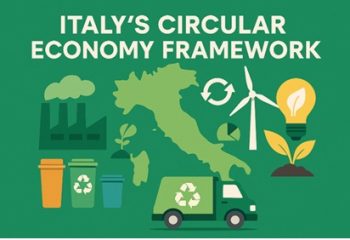
Figure: Illustrative representation of Italy’s circular economy framework, highlighting the integration of waste management, renewable energy, and resource efficiency systems. Source: AI-generated graphic elaborated by the authors based on SEC, PNGR and SNSvS frameworks
Read more:
National Circular Economy Strategy (Italy): https://www.mase.gov.it/portale/national-strategy-for-the-circular-economy-sec-
National Waste Management Programme (PNGR): https://www.mase.gov.it/portale/documents/d/guest/pngr_finale-pdf
National Sustainable Development Strategy (SNSvS): https://www.mase.gov.it/portale/web/guest/la-snsvs ; https://www.mase.gov.it/portale/web/guest/le-relazioni-annuali-sullo-stato-di-attuazione
Italian Circular Economy Report 2024 https://circulareconomynetwork.it/rapporto-sulleconomia-circolare-in-italia-2024 ; https://www.fondazionesvilupposostenibile.org/presentato-il-nuovo-rapporto-sulleconomia-circolare-italia-mantiene-la-leadership-in-europa/
https://www.lanuovaecologia.it/riciclo-italia-terzo-posto-eurostat-2024/
https://www.ricicloinitalia.it/rapporto-2025/
https://www.ilsole24ore.com/art/rifiuti-italia-prima-europa-tasso-riciclo-all-856percento-AGBWKEkB
PNRR – Mission 2 Circular Economy: https://www.mase.gov.it/portale/missione-2-m2-rivoluzione-verde-e-transizione-ecologica
PNRR – National Recovery and Resilience Plan – https://www.europarl.europa.eu/RegData/etudes/BRIE/2021/698847/EPRS_BRI(2021)698847_EN.pdf
Circular Economy Report 2026 (Italy): https://circulareconomynetwork.it/wp-content/uploads/2026/05/Report-on-Circular-Economy-in-Italy-2026-Summary.pdf
IEA Bioenergy Task 36: https://task36.ieabioenergy.com