

Residual municipal solid waste in a circular economy The Finnish case and what others can learn from it
Reaching EU recycling targets needs more than policy ambition.
Sorting systems are a real bottleneck. And the gap is larger than expected.
Main take‑aways
- Meeting EU recycling targets requires very high source separation performance
Achieving a 60% MSW recycling rate requires 70–90% separate collection efficiency for most material fractions—far above current levels in many countries. - Incremental improvements are insufficient
Even a relatively modest increase (e.g. +10 percentage points recycling) demands substantial system improvements. - Separate collection is the dominant lever for higher recycling
Across all scenarios, improving source separation has the strongest impact on total MSW recycling, especially for large fractions like bio-waste. - Central (post-)sorting is a useful complement—but not a substitute
Central sorting significantly increases plastics recovery but only marginally increases overall MSW recycling rates, since it targets a limited share of waste. - Plastics recovery can be substantially increased through combined strategies
Both enhanced separate collection (i.e. source-sorting by inhabitants) and central sorting can more than double plastics recovery, highlighting high untapped potential in EU systems. - Sorting improvements create a trade-off with energy recovery
Diverting recyclables—especially plastics—reduces residual waste volumes and calorific value, directly affecting Waste-to-Energy energy output. - Biowaste sorting is system-critical
Increasing biowaste separation both boosts overall recycling rates and, in conjunction with plastic sorting, stabilizes calorific value of residual waste, mitigating negative impacts on WtE systems. - Energy systems must adapt to higher recycling levels
Maintaining WtE energy output may require system adjustments (e.g. alternative fuels or waste imports) when recycling increases. - Policy targets require structural, not marginal, system changes
Plausible scenario analysis show that current policy-driven improvements (e.g. national waste plans) are insufficient to reach 2030 targets, implying a need for stronger incentives, infrastructure expansion, and, last but not least, behavioural change. - Data quality is a critical bottleneck for decision-making
Reliable data on waste composition and sorting efficiency is essential; uncertainties in plastics and sorting performance have a large impact on outcomes. - The modelling approach is transferable across the EU
The material flow + scenario methodology adopted in this study can be directly applied to other EU countries by adapting input data, enabling comparable policy analysis and planning.
The study shows that high recycling targets cannot be reached without major improvements in source separation, supported—but not replaced—by central sorting. At the same time, trade-offs with energy recovery and system-level implications must be actively managed, especially in countries with established WtE infrastructure.
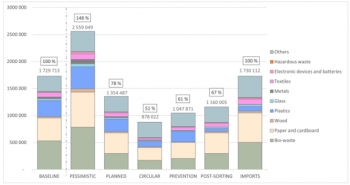
Volumes and composition of MSW to WtE in different scenarios (see publication for details). The percentages display the generated residual waste volumes in comparison to BASELINE scenario.
This article is only one of many exciting studies carried out in two Nordic projects on waste treatment and circular economy – MSWPlast (Finland) and CircWtE (Norway). For further interesting lessons learned and insights, see their final reports:
Read the article: https://doi.org/10.1016/j.clwas.2026.100531